

Topics
06/20/2024
Overfeeding Studies and Obesity: Is Weight Gained Through Short-Term Overfeeding Maintained?
Summary
1. In the late 1960s, an overfeeding experiment conducted by Ethan Sims et al. in Vermont resulted in an average weight gain of approximately 9–11 kg over about 200 days. However, when participants returned to their usual diets after the experiment, most returned to near their original weight.
2. George Bray, who had participated in this study as a co-investigator, conducted an overfeeding experiment on himself in 1972 and gained about 10 kg over 10 weeks. After the experiment ended, however, his weight declined rapidly, returning to baseline within about six weeks.
3. In 1990, an overfeeding study involving 12 pairs of identical twins resulted in an average weight gain of 8.1 kg over 100 days, approximately 67% of which was body fat. However, there was substantial individual variation in weight gain, suggesting that genetic factors play an important role in determining changes in body weight and body composition.
4. In 1995, Leibel et al. examined energy expenditure (EE) after body weight was reduced by 10–20% below the usual weight or increased by 10% through overfeeding. The results suggested that maintaining body weight below or above its usual level induces changes in EE that oppose the change in weight, potentially acting to return body weight toward its previous level.
5. A decrease or increase in EE beyond what would be predicted from changes in body weight and body composition is referred to as “metabolic adaptation.” While metabolic adaptation during weight loss has been observed relatively consistently, findings are mixed as to whether a similar adaptation occurs during overfeeding to dissipate excess energy.
Discussion
6. Metabolic adaptation during weight loss and the EE response to overfeeding may not necessarily be symmetrical.
7. Overfeeding experiments lasting only a few weeks to a few months do not directly replicate the mechanisms underlying obesity that develops gradually over several years. It may therefore be necessary to distinguish weight gain caused by short-term overfeeding from obesity that develops over the long term.
8. I believe this difference can be explained using the concept of a “body-weight set point.”
In this model, obesity that develops over the long term involves an upward shift in the body-weight set point due to genetic and environmental factors, whereas temporary weight gain caused by overfeeding occurs without a change in the set point itself.
【Full text】
-
Contents
-
- Can overeating alone make people obese?
- Subsequent overfeeding studies
- Can metabolism explain the return of body weight after overfeeding?
- Discussion
1. Can overeating alone make people obese?
Until the 1960s, obesity was widely attributed primarily to “overeating” and a “lack of willpower,” and relatively little research focused on the biology of obesity itself. However, this view was significantly influenced by overfeeding experiments conducted by Professor Ethan Sims and his colleagues in the late 1960s [1].
Sims et al. conducted a long-term overfeeding study among inmates at the Vermont State Prison, with the goal of increasing their body weight by approximately 15–30%.
The results showed substantial individual variation in both the amount of weight gained and the energy intake required to reach the target weight.
In many participants, endocrine and metabolic changes similar to those seen in naturally occurring obesity were also observed, suggesting that many of these changes might be consequences of obesity rather than its causes [2,3].

Subsequent reports indicated that the overfeeding experiment lasted about 200 days and that the 20 participants gained an average of about 9–11 kg. However, when their energy intake returned to normal levels after the experiment, most participants returned to near their original weight over the following weeks and months. Only two were reported to have maintained the weight they had gained [2,3].
Professor George Bray, who had participated in Sims's overfeeding study as a co-investigator, also conducted an overfeeding experiment on himself in 1972, gaining approximately 10 kg over 10 weeks.
After the experiment ended, however, his weight declined rapidly, returning to baseline within about six weeks. Four volunteers who later underwent similar overfeeding experiments also eventually returned to their baseline weight.
Bray noted that this tendency for gained weight to return toward its previous level contrasts with the difficulty obese individuals often experience in maintaining a lower weight after weight loss [1].

These overfeeding experiments showed that weight gained through short-term overfeeding is not necessarily easy to maintain over the long term. Furthermore, they suggest that biological factors not fully explained by energy intake alone may be involved in the development and maintenance of obesity [1].
2. Subsequent overfeeding studies
■In 1990, researchers at Laval University conducted an overfeeding study involving 12 pairs of sedentary male identical twins. Each participant's daily energy requirements were measured before the experiment, after which they consumed an additional 1,000 kcal per day over a 100-day period (six days per week, for a total of 84 days). The participants lived in a university dormitory and were under staff supervision 24 hours a day [4].
On average, body weight increased by 8.1 kg, of which 5.4 kg (approximately 67%) was body fat. However, there was substantial individual variation in weight gain, ranging from 4.3 to 13.3 kg [4].

(Source: Magnific)
By comparing differences within and between twin pairs, the study suggested that genetic factors play an important role in determining changes in body weight and body composition even under the same degree of energy surplus [4].
Four months after the experiment ended, the twins had lost approximately 7 of the 8 kg they had gained during overfeeding, returning to near their baseline weight [5].
■Leaf and Antonio reviewed overfeeding studies conducted up to 2017 that reported changes in body weight and body composition. They identified 25 studies that reported changes in fat mass (FM) and fat-free mass (FFM) in addition to weight gain, with study durations ranging from 9 to 100 days. With the exception of four studies, all involved populations with low levels of habitual physical activity [6]. Because the studies had different objectives, changes in body weight several months after the overfeeding period were not necessarily reported.
The review summarized the 25 studies according to dietary composition.
Among them, 10 studies used diets relatively high in carbohydrates and fat and relatively low in protein (11–15% of total energy intake). In these studies, most of the weight gained was FM, accounting for approximately 60–70% of the total weight gain. The authors also noted that, in the absence of exercise, much of the increase in FFM may reflect increases in body water rather than skeletal muscle [6,7].
In contrast, even with a similar energy surplus, higher-protein diets were associated with less gain in FM and more favorable changes in body composition [6,8].
3. Can metabolism explain the return of body weight after overfeeding?
Energy expenditure (EE) increases with overfeeding and weight gain. This is because resting energy expenditure, diet-induced thermogenesis, and energy expenditure from physical activity all increase[9].
An increase in EE beyond what would be predicted from changes in body weight and body composition is referred to as “metabolic adaptation” [9,10].
Historically, this concept is thought to have originated from early observations that body weight did not increase as much as expected despite increased food intake. Researchers hypothesized that there might be an adaptive mechanism of energy expenditure that acts to dissipate excess energy [1,10].
Subsequent studies have made it possible to strictly control energy intake and examine the various components of EE in greater detail [10]. However, studies have produced inconsistent findings regarding the extent to which metabolic adaptation occurs in response to overfeeding [11,12,13].
■In 1995, Leibel et al. examined energy expenditure (EE) in 18 individuals with obesity and 23 who had never been obese after their body weight was reduced by 10–20% below their usual weight or increased by 10% through overfeeding.
They found that when body weight was maintained at 10% or more below the usual level, total daily EE decreased by approximately 6–8 kcal/kg FFM.
In contrast, when body weight was maintained at 10% above the usual level, EE increased by approximately 8–9 kcal/kg FFM.
Similar changes were observed in both individuals with obesity and those who had never been obese [9].
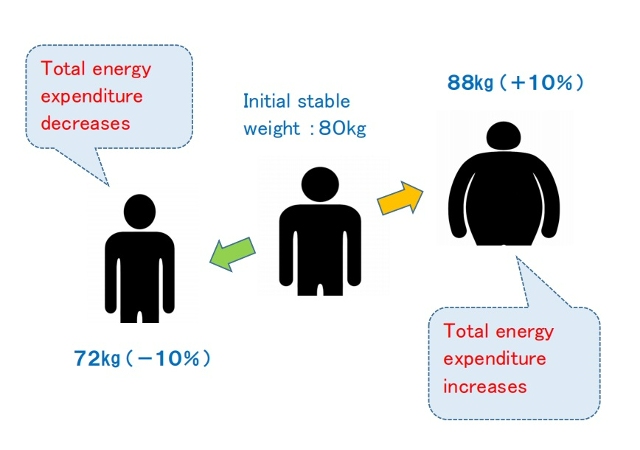
The study suggested that maintaining body weight below or above its usual level may induce changes in EE that oppose the change in weight, potentially acting to return body weight toward its previous level [9].
■Johannsen et al. studied 35 young adults (mean BMI, 25.6 ± 2.3) who consumed a diet providing 40% more energy than their baseline energy requirements for eight weeks. Sleeping metabolic rate (SMR), sedentary 24-hour energy expenditure (24h-EE), and other measures were assessed before and after overfeeding.
On average, participants gained 7.5 kg (range, 2.3–10.7 kg), of which 4.2 kg—more than half—was fat. Overfeeding increased SMR, sedentary 24h-EE, and EE on average, although there was substantial individual variation in these responses [10].

(Source: Magnific)
In addition, participants whose SMR was lower than predicted at baseline retained more of the fat gained during overfeeding six months after the experiment.
In contrast, those whose sedentary 24h-EE was higher than predicted after overfeeding lost more fat over the following six months [10].
The researchers noted that EE responses to overfeeding vary considerably among individuals and suggested that metabolic characteristics sometimes described as “thrifty” and “spendthrift” phenotypes [14,15] may be related to how body weight and body fat return toward their previous levels after overfeeding [10].
4. Discussion
(1) Metabolic adaptation to overfeeding
During weight loss, metabolic adaptation—a reduction in EE beyond what would be expected—is observed relatively consistently. In contrast, findings are inconsistent as to whether a similar metabolic adaptation occurs during overfeeding to dissipate excess energy [10].
Some studies have reported metabolic adaptation in response to overfeeding [4,7,16], whereas others have found that much of the increase in EE can be explained by the normal increase in energy requirements associated with gains in body weight and changes in body composition [12,13,17,18]. In the study by Johannsen et al., no clear metabolic adaptation to overfeeding was observed overall, although there was substantial individual variation in the response [10].
These findings suggest that metabolic adaptation during weight loss and the EE response to overfeeding may not necessarily be symmetrical.
(2) Temporary weight gain and long-term obesity
As discussed above, there is substantial individual variation in how body weight and EE respond to overfeeding. However, most overfeeding experiments last only a few weeks to a few months and therefore do not fully replicate the processes underlying obesity that develops gradually over several years.
I believe this difference may be explained using the concept of a “body-weight set point.”
For example, if a person whose weight is normally stable at 70 kg temporarily increases to 73 kg as a result of overeating, this can be viewed as a change caused by increased energy intake.
Using a glass of water as an analogy, this would be like water swelling above the rim of a full glass due to surface tension (Fig. 1).
Conversely, maintaining a weight of 65 kg by reducing food intake could be compared to a temporary drop in the water level.
In either case, the size of the glass itself—that is, the body-weight set point—remains unchanged.
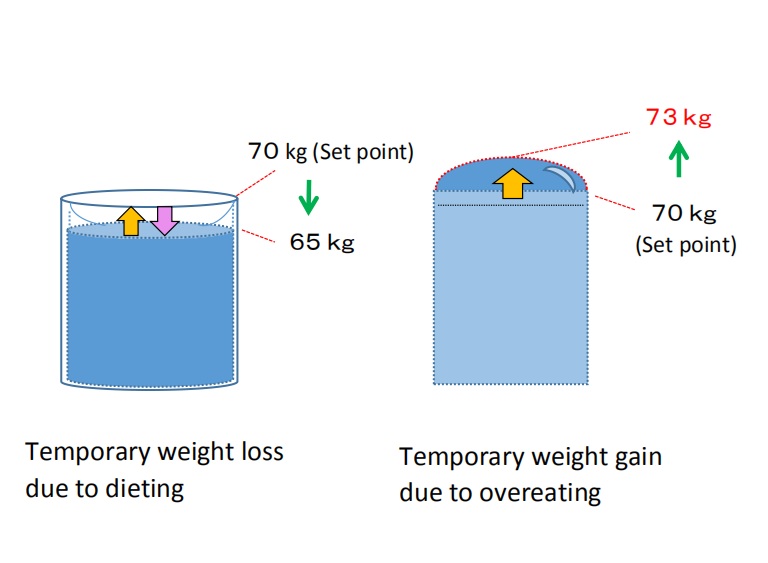
Fig. 1. A glass-of-water analogy (1)
On the other hand, if a person whose weight had been stable at 70 kg gradually comes to maintain a stable weight of 80 kg over several years, this could be viewed as the glass itself becoming larger—in other words, as an upward shift in the body-weight set point (Fig. 2).
In this model, the set point itself is considered to change over the long term in response to genetic and environmental factors.
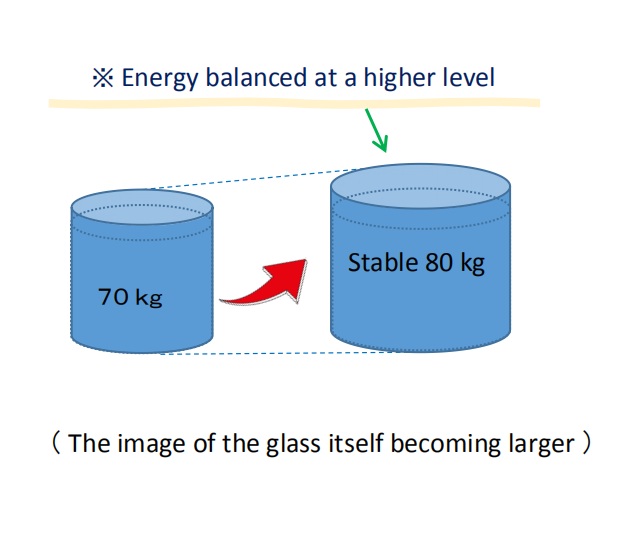
Fig. 2. A glass-of-water analogy (2)
I believe that an upward shift in the body-weight set point may involve adaptive physiological responses that occur when the body perceives a state of starvation. However, this has not been directly demonstrated by overfeeding experiments; rather, it is a hypothesis proposed in this blog.
Final thoughts
What these overfeeding studies show is that although overfeeding can increase body weight, the weight gained is not necessarily maintained. Weight gain resulting from short-term overfeeding may therefore need to be distinguished from obesity as a chronic condition that develops over several years.
As Bray has pointed out, the history of these overfeeding and underfeeding studies suggests that preventing and treating obesity may require more than the traditional advice to simply “eat less and exercise more” [1].
<References>
[1]Bray GA. The pain of weight gain: self-experimentation with overfeeding. Am J Clin Nutr. 2020 Jan 1;111(1):17-20.
[2]Sims EA et al. Experimental obesity in man. Trans Assoc Am Physicians. 1968;81:153-70. PMID: 5721398.
[3]Sims EA et al. Endocrine and metabolic effects of experimental obesity in man. Recent Prog Horm Res. 1973;29:457-96. doi: 10.1016/b978-0-12-571129-6.50016-6. PMID: 4750591.
[4]Bouchard C et al. The response to long-term overfeeding in identical twins. N Engl J Med. 1990 May 24;322(21):1477-82.
[5] Bouchard C et al. Overfeeding in identical twins: 5-year postoverfeeding results. Metabolism. 1996 Aug;45(8):1042-50.
[6]Leaf A, Antonio J. The Effects of Overfeeding on Body Composition: The Role of Macronutrient Composition - A Narrative Review. Int J Exerc Sci. 2017 Dec 1;10(8):1275-1296.
[7]Norgan NG, Durnin JV. The effect of 6 weeks of overfeeding on the body weight, body composition, and energy metabolism of young men. Am J Clin Nutr. 1980 May;33(5):978-88.
[8].Bray GA et al. Effect of protein overfeeding on energy expenditure measured in a metabolic chamber. Am J Clin Nutr. 2015 Mar;101(3):496-505.
[9]Leibel RL, Rosenbaum M, Hirsch J. Changes in energy expenditure resulting from altered body weight. N Engl J Med. 1995 Mar 9;332(10):621-8.
[10]Johannsen DL et al. Metabolic adaptation is not observed after 8 weeks of overfeeding but energy expenditure variability is associated with weight recovery. Am J Clin Nutr. 2019 Oct 1;110(4):805-813.
[11]Westerterp, K. Metabolic adaptations to over—and underfeeding—still a matter of debate?. Eur J Clin Nutr 67, 443–445 (2013).
[12]Ravussin E et al. Short-term, mixed-diet overfeeding in man: no evidence for "luxuskonsumption". Am J Physiol. 1985 Nov;249(5 Pt 1):E470-7.
[13]Diaz EO et al. Metabolic response to experimental overfeeding in lean and overweight healthy volunteers. Am J Clin Nutr. 1992 Oct;56(4):641-55.
[14]Reinhardt M et al. A Human Thrifty Phenotype Associated With Less Weight Loss During Caloric Restriction. Diabetes. 2015 Aug;64(8):2859-67.
[15]Schlögl M et al. Energy Expenditure Responses to Fasting and Overfeeding Identify Phenotypes Associated With Weight Change. Diabetes. 2015 Nov;64(11):3680-9.
[16] Webb P, Annis JF. Adaptation to overeating in lean and overweight men and women. Hum Nutr Clin Nutr. 1983 Mar;37(2):117-31.
[17] Forbes GB et al. Deliberate overfeeding in women and men: energy cost and composition of the weight gain. Br J Nutr. 1986 Jul;56(1):1-9.
[18]Roberts SB et al. Energy expenditure and subsequent nutrient intakes in overfed young men. Am J Physiol. 1990 Sep;259(3 Pt 2):R461-9.