
Topics
06/22/2019
Obesity as a Multifactorial Condition: Does Intestinal Starvation Act as a Confounding Factor?
-
Contents
-
- "Overeating causes obesity" is too simplistic
- Most diet methods are "partially correct"
- Can environmental and behavioral factors be systematically organized?
- Intestinal starvation as a confounding factor
The bottom line
1. "Overeating causes obesity" is too simplistic
A 2012 online survey of 1,143 adults in the United States conducted by Reuters and the market research firm Ipsos found that 61% of American adults believed "personal choices related to diet and exercise" were responsible for the obesity epidemic[1,2]. In other words, many Americans still hold the belief that people who become obese lack willpower, overeat, and do not exercise enough[2].
The situation in Japan appears to be similar. Even news anchors and experts frequently make statements such as, “It's only natural to gain weight if you overeat and don’t exercise,” suggesting that many Japanese people likely hold the same view.
However, scientific research indicates that "personal choices" may not account for all cases of obesity[2].
Classical genetic studies based on adoption studies, family studies, twin studies, etc., indicate that about 50–70% of the variance (heritability estimates) in BMI is genetic (Those estimates vary depending on the study design and assessment methods) [3].
Even today, the heritability of obesity is estimated at 40% to 70%[4].

Some researchers point out that numerous different genes have been found to be involved in food selection, food intake, absorption, metabolism, and energy expenditure including physical activity. When considering interactions between gene-by-gene or gene(s)-by-environment(s), the complexity of the mechanisms underlying weight regulation becomes even greater[3].
International Statements Recognizing Obesity as a Chronic Disease
・In 1948, the World Health Organization (WHO) established the International Classification of Diseases (ICD) and classified obesity as a disease. This is considered one of the earliest official frameworks in which obesity was treated as an illness.
However, at the time, this classification received little attention within the medical community and was not widely regarded as clinically important for several decades thereafter[5].
・In 1997, following consultations with the International Obesity Task Force (IOTF, now part of the World Obesity Federation), the WHO clearly identified obesity as a complex and serious chronic disease in an official report[6].
・In 2012, the American Association of Clinical Endocrinologists (AACE) designated obesity as a chronic disease. This designation was based on the recognition that the pathophysiology of obesity is complex, involving interactions among genetic and biological factors, the environment, and behavior, and that obesity meets the definition of a disease as outlined by the American Medical Association (AMA)[7].
・Subsequently, in 2013, the American Medical Association (AMA) formally recognized obesity as a chronic disease[8].
2. Most diet methods are partially correct
If we accept that the human gene pool is unlikely to change substantially over a period of 50 or even 100 years, then the global rise in obesity observed since the 1970’s can reasonably be understood as being strongly influenced by environmental and behavioral factors.
With this in mind, I would like to take a closer look at these factors. An interesting observation about recent popular diets is particularly relevant here and is quoted below.
“What causes weight gain? Contending theories abound:
・Calories ・Food reward・Food addiction
・Sugar・Sleep deprivation ・Stress
・Refined carbohydrates・Wheat
・Low fiber intake・All carbohydrates
・Genetics・Dietary fat ・Red meat
・Poverty ・All meat・Wealth
・Dairy products・Gut microbiome
・Snacking・Childhood obesity

The various theories fight among themselves, as if they are all mutually exclusive and there is only one true cause of obesity. For example, recent trials that compare a low-calorie to a low-carbohydrate diet assume that if one is correct, the other is not. Most obesity research is conducted in this manner.
This approach is wrong, since these theories all contain some element of truth. (*snip*)
THE MULTIFACTORIAL NATURE of obesity is the crucial missing link. There is no one single cause of obesity. (*snip*)
What we need is a frame work, a structure, a coherent theory to understand how all its factors fit together. Too often, our current model of obesity assumes that there is only one single true cause, and that all others are pretenders to the throne. Endless debates ensue.
Too many calories cause obesity. No, too many carbohydrates. No,
too much saturated fat. No, too much red meat. No,
too much processed foods. No, too much high fat dairy. No,
too much wheat. No, too much sugar. No,
too much highly palatable foods. No, too much eating out. No
It goes on and on. They are all partially correct. (*snip*)
All diets (e.g., calorie restriction, low-fat, paleo, vegan) work because they all address a different aspect of the disease. But none of them work for very long, because none of them address the totality of the disease.
Without understanding the multifactorial nature of obesity-which is critical -we are doomed to an endless cycle of blame."
(Jason Fung. The Obesity Code. Greystone Books. 2016. Pages 70, 216-217.)
I find the author’s discussion of the multifactorial nature of obesity to be highly insightful. Obesity is not a simple phenomenon caused solely by overeating; rather, it arises from a complex interplay of multiple factors, and this is a point we must first recognize.
However, at the same time, the sheer number of factors that are often listed suggests another problem: the mechanisms and contributing factors behind weight gain have not been sufficiently organized or clearly conceptualized.
I believe that by introducing the concept of intestinal starvation, some of the environmental and behavioral factors that appear complex can be viewed in a more structured and coherent way. By shifting our focus away from observable eating habits and lifestyle patterns and toward the unseen workings of the intestines, the underlying mechanisms of obesity may become more apparent.
3. Can environmental and behavioral factors be systematically organized?
Here, it is worth reaffirming that the phenomenon commonly described as “gaining weight” actually involves two distinct processes. Introducing this conceptual framework makes it easier to organize and understand the many factors that contribute to weight gain.
【Related article】
The Two Distinct Processes Behind Weight Gain
(1) When body weight returns to its original set point
One type of weight gain occurs when body weight, which has been intentionally kept low, begins to return toward its set point. This process is illustrated in Figure 1A.
Not only the weight gain commonly explained as resulting from overeating or lack of exercise, but also many calorie-restricted diets and traditional weight-loss intervention studies fall into this category.
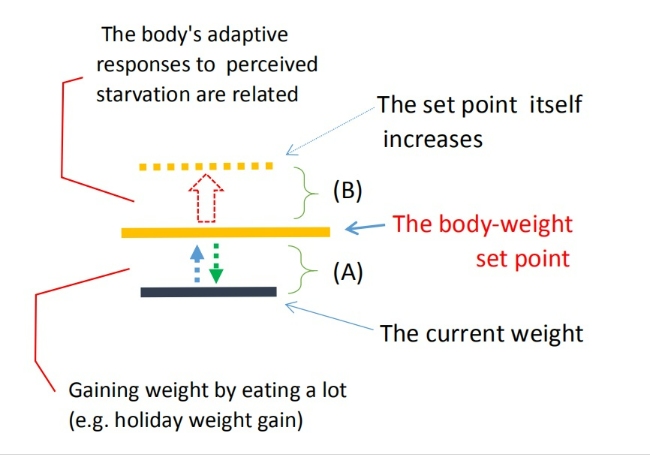
Fig. 1
Admittedly, regardless of whether fat, carbohydrates, or ultra-processed foods are restricted, body weight tends to decrease temporarily as long as energy intake falls below energy expenditure.
However, because this approach does not alter the underlying body-weight set point, making long-term weight loss maintenance difficult and increasing the likelihood of weight rebound once previous eating patterns resume.
As Dr. Briffa has pointed out, calorie restriction may serve as a temporary remedy, but it is not a fundamental solution to obesity as a whole.
(2) The process by which the set point itself increases
In contrast, the weight gain illustrated in Figure 1B represents a situation in which the body-weight set point itself increases. I propose that this type of weight gain is the result of an adaptive response to the body’s recognition of “starvation.”
One form of this “perceived starvation” is intestinal starvation. Intestinal starvation does not arise from a single cause; rather, it emerges through the simultaneous involvement of multiple factors. This perspective may help clarify the multifactorial nature of obesity, particularly its relationship with environmental and behavioral factors.
【Related article】
Three (+1) Factors That Accelerate “Intestinal Starvation”
4. Intestinal starvation as a confounding factor
Skipping breakfast, eating late dinners, having fewer meals per day, diets high in refined carbohydrates or (ultra-)processed foods, insufficient dietary fiber, and unbalanced diets are often reported to be associated with weight gain and obesity.
What is important, however, is that these factors may not independently cause obesity. Instead, they may influence the occurrence of intestinal starvation.
In other words, I suggest that the core causal factor in obesity may not be individual lifestyle behaviors themselves, but rather intestinal starvation, which is commonly affected by these behaviors.
In this sense, intestinal starvation may be conceptualized as a physiological response that functions as a confounding factor (see Note 1) in obesity research.
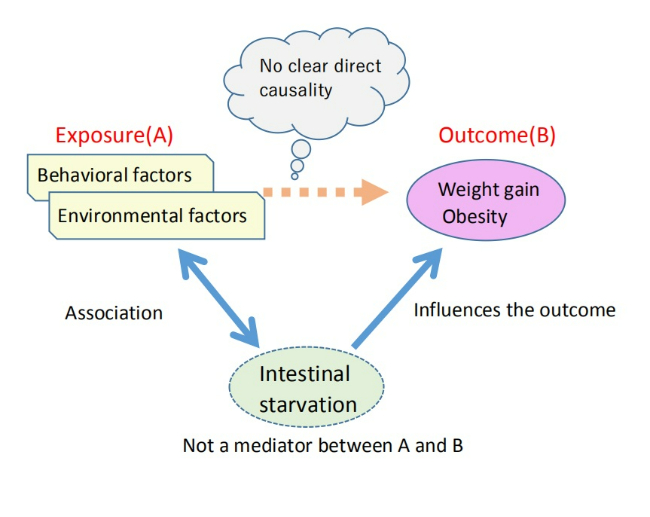
Fig. 2. Conceptual framework of intestinal starvation acting in a confounding-like manner
Note 1: A confounding factor is a third variable that influences both the presumed cause (exposure) and the outcome, thereby obscuring the true relationship between them. For example, even if low dietary fiber intake appears to be associated with obesity, intestinal starvation may be an underlying factor that affects both.
The bottom line
(1)Obesity is now widely recognized as a chronic, multifactorial disease driven by interactions among genetic, biological, environmental, and behavioral factors. While many fad diets address specific aspects of obesity, none adequately targets the condition as a whole, which may explain their limited long-term effectiveness.
(2)What is needed now is a conceptual framework that explains how multiple factors interact. By adopting the perspectives outlined below, environmental and behavioral factors related to obesity can be more clearly organized and understood.
(a) There are two distinct processes that lead to weight gain, and one of them—an upward shift in the body-weight set point—is closely associated with the rise in obesity.
(b) Intestinal starvation is involved in this upward shift of the set point itself. It represents an adaptive physiological response that arises at the intersection of genetic factors and the modern food environment and lifestyle, and thus may help explain the multifactorial nature of obesity.
(3) From this perspective, the central causal factor in obesity may not be individual lifestyle behaviors themselves, but rather intestinal starvation, which is commonly influenced by these factors. In this sense, intestinal starvation can be viewed as a biological response that functions as a confounding factor in obesity research.
References
[1]Begley S. America's hatred of fat hurts obesity fight. Reuters. May 11, 2012.
[2]Jou C. The biology and genetics of obesity--a century of inquiries. N Engl J Med. 2014 May 15;370(20):1874-7.
[3]Speakman JR et al. Set points, settling points and some alternative models: theoretical options to understand how genes and environments combine to regulate body adiposity. Dis Model Mech. 2011 Nov;4(6):733-45.
[4]McPherson R. Genetic contributors to obesity. Can J Cardiol. 2007 Aug;23 Suppl A(Suppl A):23A-27A.
[5]James, W. WHO recognition of the global obesity epidemic. Int J Obes 32 (Suppl 7), S120–S126 (2008).
[6]Obesity as a Disease.The World Obesity Federation
[7] Garvey WT. Is Obesity or Adiposity-Based Chronic Disease Curable: The Set Point Theory, the Environment, and Second-Generation Medications. Endocr Pract. 2022 Feb;28(2):214-222.
[8] Garvey WT et al. American Association of Clinical Endocrinologists and American College of Endocrinology Comprehensive Clinical Practice Guidelines for Medical Care of Patients with Obesity. Endocr Pract. 2016 Jul;22 Suppl 3:1-203.