
Topics
03/15/2016
The Two Distinct Processes Behind Weight Gain
-
Contents
-
- When body weight returns to its original set point (A)
- When the body-weight set point itself increases (B)
- The coexistence of mechanisms A and B in weight gain
In everyday conversation, weight gain is often understood simply as “an increase in body weight (usually body fat)” compared with the past. However, this expression may lump together multiple processes that are physiologically distinct.
To make the discussion easier to follow, the complex phenomena involved in weight gain are deliberately divided here into two processes as a hypothetical framework.
For example, the idea that eating high-calorie foods leads to weight gain is widely shared. In contrast, understanding phenomena such as weight rebound after dieting—sometimes resulting in greater weight gain than before—requires a more explicitly physiological perspective.
I believe that because these qualitatively different processes of weight gain have often been discussed without clear distinction, misleading information about weight loss may have spread, leading many people to engage in dieting practices that are not necessarily appropriate or effective.
【Related article】
The Increasingly Important "Set-Point" Theory of Body Weight
1. When body weight returns to its original set point (A)
The first type of “weight gain” reflects, and arises as part of, the body’s homeostatic drive to return to its set point (Fig. 1A).
Many people who are overweight, or tend to gain weight easily, deliberately try to keep their body weight lower by reducing their daily caloric intake and/or increasing physical activity.
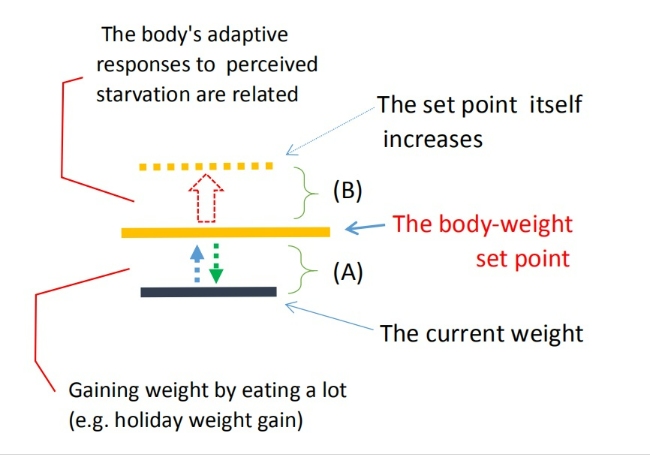
Fig. 1. The two distinct processes of weight gain
Under such conditions, the body often acts in the direction of restoring the set point for body weight. So it is no surprise that if they begin eating more and caloric intake increases, their weight naturally increases.
(Note: Temporary overeating may cause body weight to increase slightly beyond the body-weight set point. However, such weight gain is typically transient and is unlikely to reflect a true change in the set point itself.)
In many countries, people often talk about “holiday weight gain” or say that high-calorie foods inevitably make them gain weight. Some also claim, “I gain weight as soon as I eat a little more.”
But in most cases, these experiences can be explained by the homeostatic mechanism that pulls body weight back toward its set point—meaning that the person is simply repeating small cycles of “mini-diets” followed by “mini-rebounds.”
A helpful analogy is a glass of water: the water level may rise or fall temporarily, but the size of the glass itself does not change(Fig. 2).
Similarly, when temporary overeating pushes body weight slightly above the set point, it is like water swelling above the rim of a full glass due to surface tension.
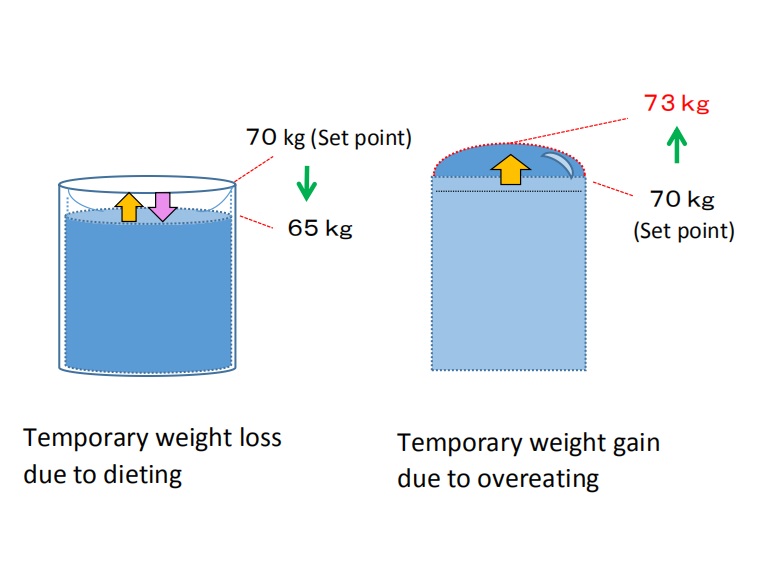
Fig. 2. The glass-of-water analogy (1)
2. When the body-weight set point itself increases (B)
In contrast, the second type of “weight gain” refers to cases in which the body-weight set point itself gradually increases (Fig. 1B).
I propose that an upward shift in the body-weight set point is associated with the body’s adaptive responses to perceived starvation. Broadly speaking, the body is thought to perceive starvation through two major pathways: one is a severe energy deficit caused by excessive caloric restriction, and the other is what I describe in this blog as “intestinal starvation.”
【Related article】
Biological Responses Driving Weight Rebound After Weight Loss
Here, I will focus on the latter—cases in which an increase in the body-weight set point is thought to be primarily associated with intestinal starvation.
This pattern can be observed in people who are mindful of their caloric intake and keep breakfast or lunch light—such as opting for a simple burger or sandwich, or instant noodles—yet still find themselves saying, “I’ve gained three kilos over the past year,” or “I’m ten kilos heavier than I was three years ago.”
This phenomenon cannot be adequately explained by simple calorie balance alone. Rather, it suggests the possible involvement of intestinal starvation—which may be induced during prolonged periods of hunger—as well as other regulatory mechanisms in elevating the body-weight set point.
For example, imagine someone who had never exceeded 70 kg but, over the course of a year, reaches a new high and stabilizes around 80 kg.
In this situation, the body-weight set point can be considered to have shifted upward from 70 kg to 80 kg, meaning that the baseline at which energy intake and expenditure are balanced has itself moved higher.
An increase in the body-weight set point can be likened, in the glass-of-water analogy introduced earlier, to the glass itself gradually becoming larger (Fig. 3).
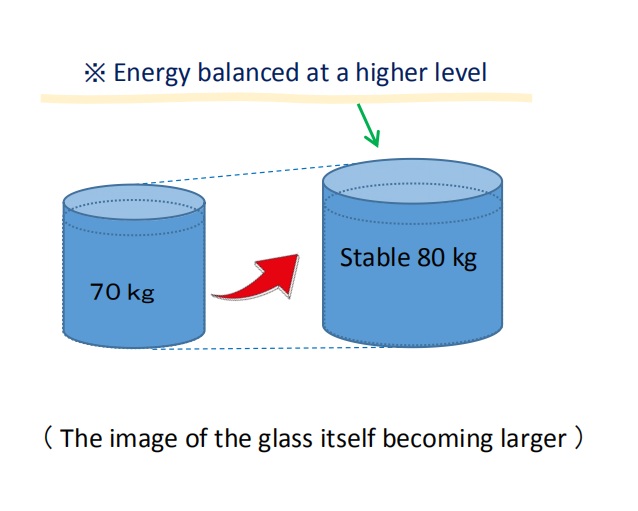
Fig. 3. The glass-of-water analogy (2)
Such a shift may contribute to more fundamental differences between individuals who tend to gain weight easily and those who remain lean.
Indeed, research on set-point theory suggests that, for some individuals, obesity may represent a “natural physiological state” in which energy balance is stably maintained at a relatively high set point for body weight[1].
3. The coexistence of mechanisms A and B in weight gain
In real-world weight gain and post-diet rebound, the mechanism for maintaining body weight (A) and the mechanism by which the set point itself increases (B) often operate simultaneously or in an overlapping manner.
For example, the common observation that most people return to their original weight after dieting can be understood as the result of a homeostatic, weight-preserving mechanism (A) described above.
In contrast, when body weight not only returns to baseline but also exceeds the previous level, a mechanism (B) that raises the set point itself may be involved. This is because, during the process of caloric restriction, conditions may arise under which the body comes to perceive itself as being in a state of starvation.
■Sumo wrestlers in Japan are well known for eating large meals and becoming very heavy. In reality, however, their weight gain can be understood as involving a combination of mechanisms (A) and (B) described above.
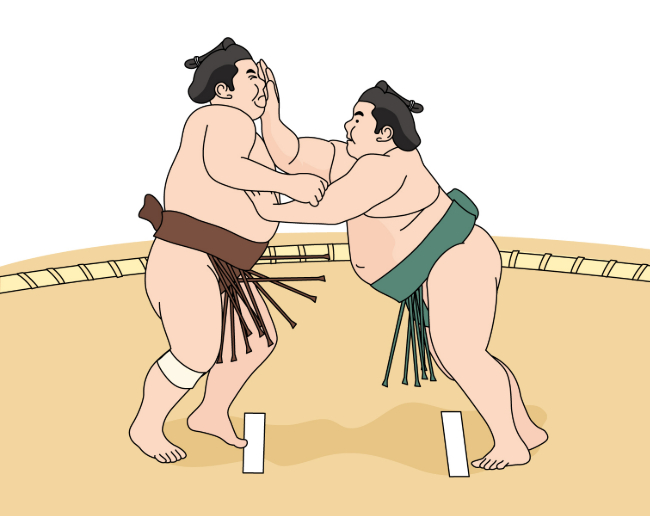
Specifically, their weight gain can be explained by a model in which the body-weight set point first increases through intestinal starvation (B), after which actual body weight rises toward this elevated set point as a result of increased food intake, consistent with mechanism (A).
From the outside, it may simply appear that they become heavier because they eat a lot.
However, the underlying process can be considered fundamentally similar to the mechanism observed in people who regain weight after dieting and ultimately become heavier than before.
【Related article】
Why Are Sumo Wrestlers So Fat?; Six Reasons They’ve Adapted to the Gut Starvation Mechanism
<References>
[1] Richard E. Keesey, Matt D. Hirvonen, Body Weight Set-Points: Determination and Adjustment, The Journal of Nutrition, Volume 127, Issue 9, 1997, Pages 1875S-1883S, ISSN 0022-3166.